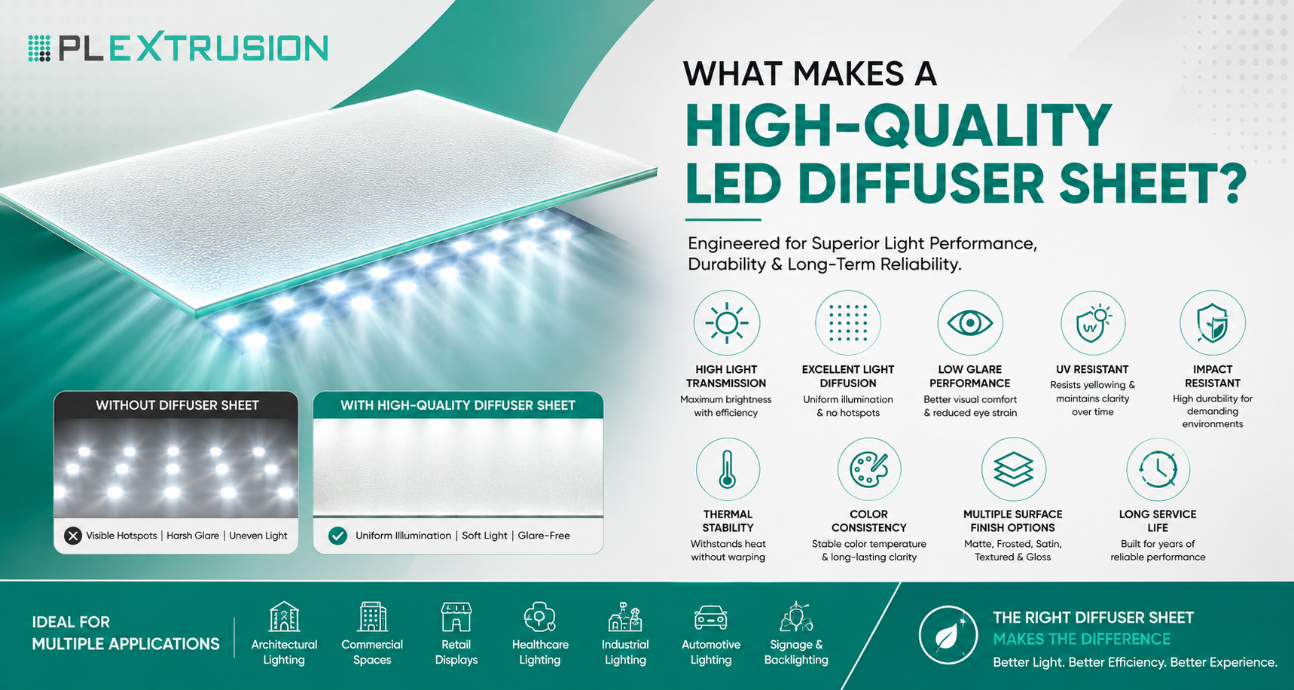
A high-quality LED diffuser sheet equally distributes light, minimizes glare, hides LED hotspots, offers high light transmission, maintains long-term optical performance, and resists yellowing, impact, and UV declination. Choosing the right diffuser sheet improves lighting efficiency, attractiveness, energy savings, and product durability across architectural, industrial, healthcare, automotive, signage, and commercial lighting applications.
An LED diffuser sheet is a special plastic sheet that spreads LED light evenly. It hides the bright LED spots and creates soft, smooth, and glare-free lighting.
The most common materials include:Other ordinary plastic sheets, LED diffuser sheets are manufactured using specialized light-diffusing additives that control how light travels through the material.
An LED diffuser sheet is an optical component that converts concentrated LED light into uniform illumination while balancing light transmission and diffusion.
Without proper diffusion, LED lighting can create:
High-quality diffusion improves both lighting performance and user comfort.
Benefits include:Several technical characteristics determine whether an LED diffuser sheet delivers premium performance.
1. High Light TransmissionLight transmission refers to the percentage of light passing through the diffuser. An ideal diffuser balances brightness with diffusion.
Typical ranges:
| Application | Recommended Transmission |
|---|---|
| Decorative lighting | 45–60% |
| General LED panels | 60–75% |
| Commercial lighting | 70–85% |
| Industrial lighting | 80–90% |
Higher transmission increases brightness while maintaining diffusion quality.
2. Excellent Light DiffusionThe primary purpose of a diffuser sheet is removing LED hotspots.
A quality diffuser:
The best LED diffuser sheets provide maximum light uniformity without significantly reducing brightness efficiency.
3. Low Glare PerformanceGlare causes eye fatigue and discomfort, particularly in offices, hospitals, schools, and retail environments.
Quality diffuser sheets help lower beam by:
This improves visual comfort in long-duration lighting environments.
4. Optical ClarityOptical clarity ensures the sheet itself does not distort the released light.
A premium diffuser offers:
Continuous exposure to sunlight may cause low-grade plastics to yellow over time.
UV-stabilized diffuser sheets offer:
This is especially important for:
Installation, transportation, and maintenance require durable materials.
High-quality sheets resist:
Polycarbonate diffusers generally offer significantly higher impact resistance than acrylic, making them suitable for demanding industrial and public environments.
7. Thermal StabilityLED fixtures generate heat during operation.
Premium diffuser sheets maintain their shape and optical performance under raised temperatures, helping prevent:
Lighting should remain consistent over years of use.
Quality diffuser sheets preserve:
Different applications require different surface textures.
Common finishes include:
Each finish affects diffusion angle and visual appearance.
10. Long Service LifePremium optical diffuser sheets are designed for years of continuous operation with minimal performance degradation.
High-quality materials maintain:
Material selection directly impacts optical performance, durability, and application suitability.
| Property | Acrylic (PMMA) | Polycarbonate (PC) |
|---|---|---|
| Optical Clarity | Excellent | Very Good |
| Light Transmission | High | High |
| UV Resistance | Excellent | Good (UV grades available) |
| Impact Strength | Moderate | Excellent |
| Temperature Resistance | Good | Excellent |
| Weather Resistance | Excellent | Very Good |
| Indoor Applications | Excellent | Excellent |
| Industrial Applications | Good | Excellent |
(Selecting the correct material depends on the operating environment rather than price alone.)
LED diffuser sheets support various industries by improving light quality, durability, and visual comfort.
Lighting & Electrical:Applications include:
Designers use diffuser sheets for:
Uniform illumination increases the overall attractive appeal.
Retail & Commercial Spaces:Retail lighting requires balanced brightness for improved product visibility:
Common applications:
Automotive lighting components include:
Consumer products include::
Medical environments require glare-free, hygienic lighting.
Applications include:
Uniform lighting improves visibility while reducing eye stress.
Industrial & Warehousing:Industrial lighting prioritizes durability and efficiency.
Typical uses:
LED diffuser sheets improve:
Even illumination creates a more professional visual presentation.
Hospitality (Hotels & Restaurants):Hospitality environments rely on soft, inviting lighting.
Applications include:
Modern connected lighting systems use diffuser sheets for:
Evaluate the following checklist:
Many lighting projects experience poor results due to incorrect diffuser selection.
Avoid:
We are Mumbai-based manufacturer specializing in precision-extruded plastic sheet solutions for lighting, industrial, architectural, and commercial applications.
The company's engineering approach focuses on:
Rather than offering one-size-fits-all products, Plextrusion India LLP develops diffuser sheet solutions customized to customer-specific lighting performance requirements
At Plextrusion India LLP, diffuser sheet selection typically begins with four key engineering considerations:
1. Optical Performance : Required balance between light transmission and diffusion.
2. Operating Environment : Indoor, outdoor, cleanroom, industrial, or high-temperature conditions.
3. Mechanical Requirements : Impact resistance, rigidity, and fabrication needs.
4. End-Use Design : Fixture geometry, LED spacing, and desired visual appearance.
This application-first approach helps optimize both lighting performance and long-term safety.
The ideal transmission depends on the application. General commercial lighting commonly uses diffuser sheets with 60–85% light transmission, balancing brightness and uniformity.
Acrylic offers superior optical clarity and UV resistance, while polycarbonate provides higher impact and heat resistance. The best choice depends on the application.
Yes. High-quality optical diffuser sheets are engineered to scatter light effectively, reducing or eliminating visible LED points when paired with appropriate fixture design.
Yes, provided they are UV-stabilized and weather-resistant. Outdoor installations also require consideration of environmental exposure and fixture protection.
A well-designed diffuser balances diffusion with high light transmission, minimizing optical losses while improving perceived lighting quality.
Service life varies with material, installation conditions, and environmental exposure. UV-resistant, optical-grade sheets are designed for long-term performance with proper maintenance.
Selecting the right LED diffuser sheet is about more than appearance. Optical performance, light transmission, diffusion efficiency, UV resistance, thermal stability, and mechanical durability all contribute to consistent, high-quality lighting.
For lighting manufacturers, architects, OEMs, and industrial users, investing in premium diffuser sheets can improve illumination quality, reduce maintenance, and enhance the longevity of lighting systems.
By combining precision extrusion, application-focused engineering, and customizable solutions, we delivers LED diffuser sheets designed to meet the diverse needs of modern lighting, architectural, industrial, healthcare, automotive, signage, hospitality, and smart lighting applications.