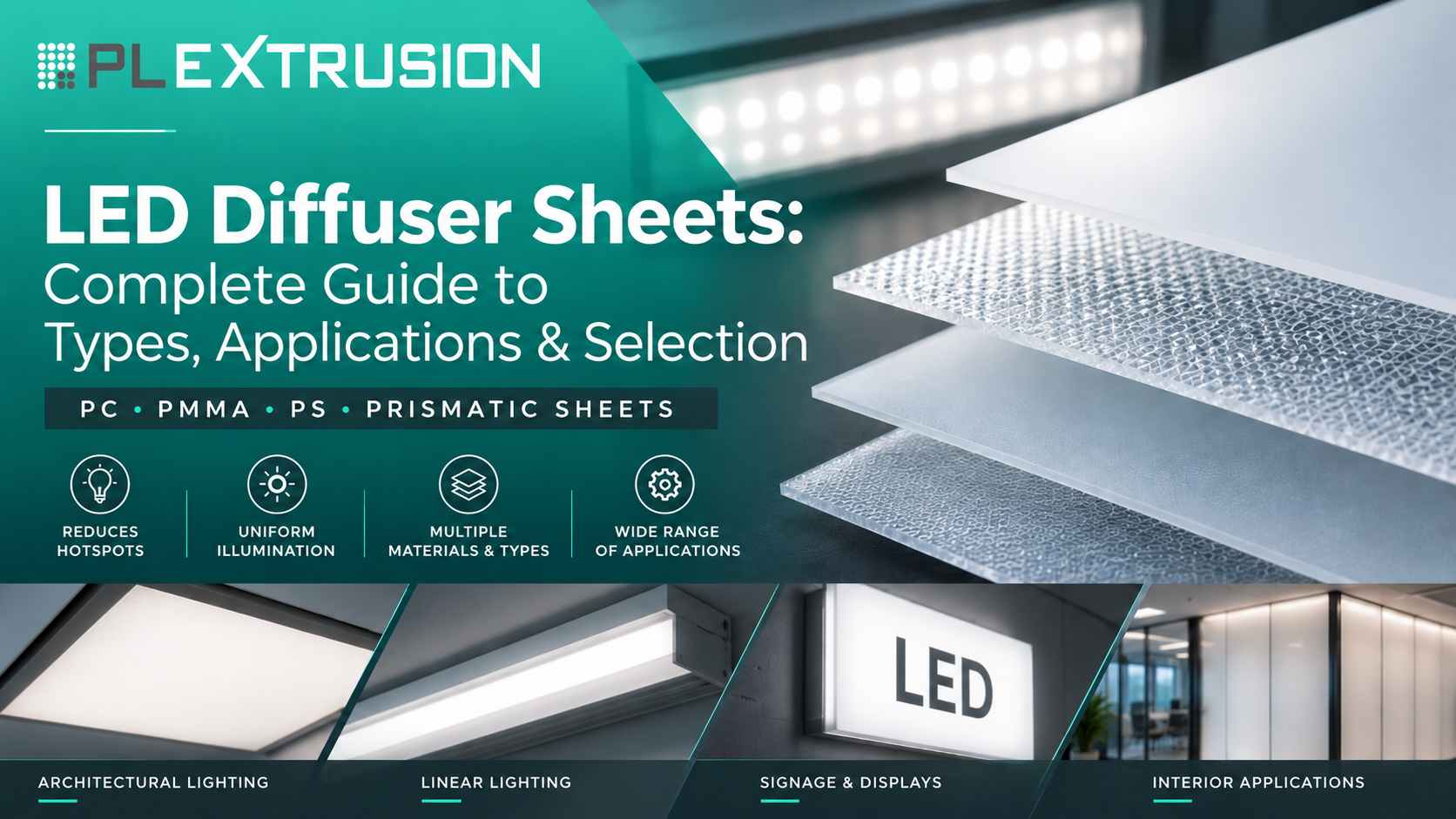
LED diffuser sheets are optical plastic sheets designed to spread LED light equally, reduce visible LED hotspots, soften glare, and create a more uniform illuminated surface. The most common materials are Polycarbonate (PC), PMMA (Acrylic), and Polystyrene (PS). The right diffuser depends on light transmission, diffusion level, thickness, impact resistance, UV exposure, surface finish, and the application's environmental requirements.
LED lighting systems are increasingly being designed around visual comfort, uniform illumination, compact fixture designs, and application-specific optical performance. In these systems, the LED diffuser sheet is more than a simple cover: it is an optical component that influences how the light source is observed and distributed.
For manufacturers of luminaires, lighting equipment, signage, displays, architectural fixtures, and OEM products, selecting the correct diffuser material and optical specification can directly affect the appearance and performance of the finished product.
An LED diffuser sheet is a light-transmitting optical plastic sheet placed between an LED light source and the illuminated area to scatter, spread, and soften light.
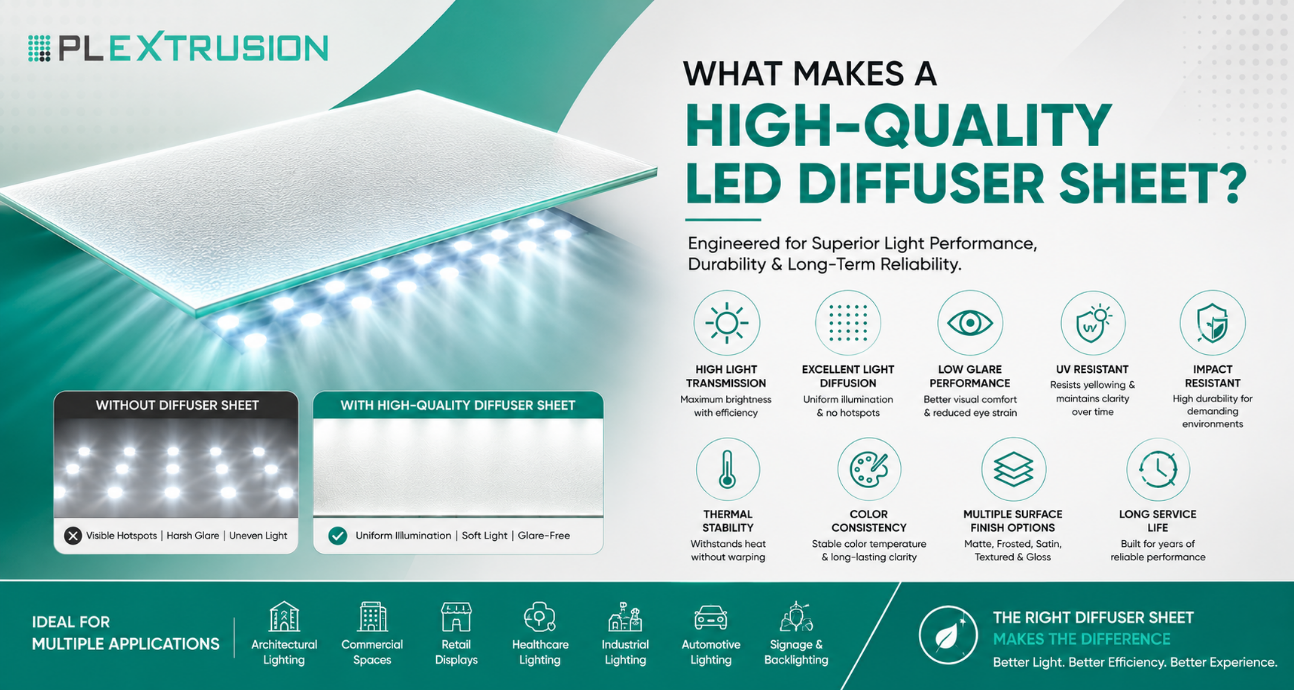
An LED chip or LED strip can produce concentrated points of light. When viewed directly through a clear cover, these points may appear as bright spots or "hotspots." A diffuser sheet modifies the path of the light so that illumination becomes more visually uniform.
How an LED diffuser sheet controls lightsThe basic optical process can be understood as:
LED source → optical diffusion → light spreading → reduced hotspots → more uniform illumination
The final result depends on several factors:
Key statement: LED diffuser performance is determined by the interaction between the diffuser material, optical surface, LED arrangement, transmission level, and luminaire design; not by material selection alone.
LED diffuser sheets are important because modern LED sources can deliver high brightness from compact packages, making light distribution and visual comfort important design considerations.
A correctly selected diffuser can help:
LED hotspot hiding means hiding the bright LED spots so the light looks smooth and even.
This characteristic is especially important for:
A diffuser with excellent LED hiding can produce a smoother illuminated appearance instead of allowing individual LED points to remain visible.
However, hotspot performance also depends on the distance between the LEDs and diffuser. A highly diffusing sheet cannot automatically compensate for every LED spacing or fixture geometry.
The main plastic materials used for LED diffuser sheets include Polycarbonate (PC), PMMA (Acrylic), and Polystyrene (PS) as the three principal plastic raw materials used for its diffuser sheets.
| Diffuser Material | Main Strength | Typical Advantage | Suitable Applications |
|---|---|---|---|
| Polycarbonate (PC) | Impact resistance | Strong and durable | Industrial, outdoor, transport, demanding fixtures |
| PMMA / Acrylic | Optical clarity | High optical performance and UV stability | Architectural, commercial, premium lighting |
| Polystyrene (PS) | Cost-effective optical solution | Suitable for standard indoor lighting | Panel lights, commercial fixtures, general illumination |
| Prismatic sheet | Light control | Directional distribution and glare management | Offices, commercial and industrial lighting |
| Custom diffuser sheet | Application-specific performance | Tailored transmission, texture, thickness and geometry | OEM and specialized lighting |
Polycarbonate (PC) is a strong engineering thermoplastic commonly selected for LED diffuser sheets where impact resistance, mechanical durability, and application-specific performance are important.
Plextrusion's PC diffuser sheet specifications include a density of 1.19 g/cm³, thickness options from 0.8 mm to 4.0 mm, and stated light transmission options of approximately 70% to 80%, depending on grade. Certain listed grades include UL 94 V-0 performance at specified thicknesses.
Typical PC diffuser sheet characteristics:
| Part Number | Light Transmission | Thickness |
|---|---|---|
| C-1270 | 70% ±2% | 1.2 mm |
| C-1570 | 70% ±2% | 1.5 mm |
| C-1575 V0 | 75% ±2% | 1.5 mm |
(These are examples from Plextrusion's published product information; the appropriate grade should be selected against the actual luminaire and environmental requirements.)
PMMA, commonly called acrylic, is a strong choice when optical clarity, appearance, and UV/weathering performance are important selection factors.
PMMA diffuser sheets are commonly considered for:
PMMA prismatic sheet information lists light transmission of approximately 80%–90% depending on surface finish and thickness, with typical thicknesses of 1.0 mm, 1.5 mm, and 2.0 mm for the listed product.
PMMA can provide:
Key statement: PMMA is generally considered when optical appearance and UV stability are more important than the higher impact resistance associated with polycarbonate.
Polystyrene (PS) diffuser sheets provide an economical solution for many indoor LED lighting applications where the mechanical and environmental requirements are moderate.
Typical applications can include:
PS can be particularly useful where the project requires a balance between optical diffusion, manufacturability, and material cost.
The correct PS grade should be selected according to the fixture design, required transmission, operating environment, temperature conditions, and applicable safety requirements.
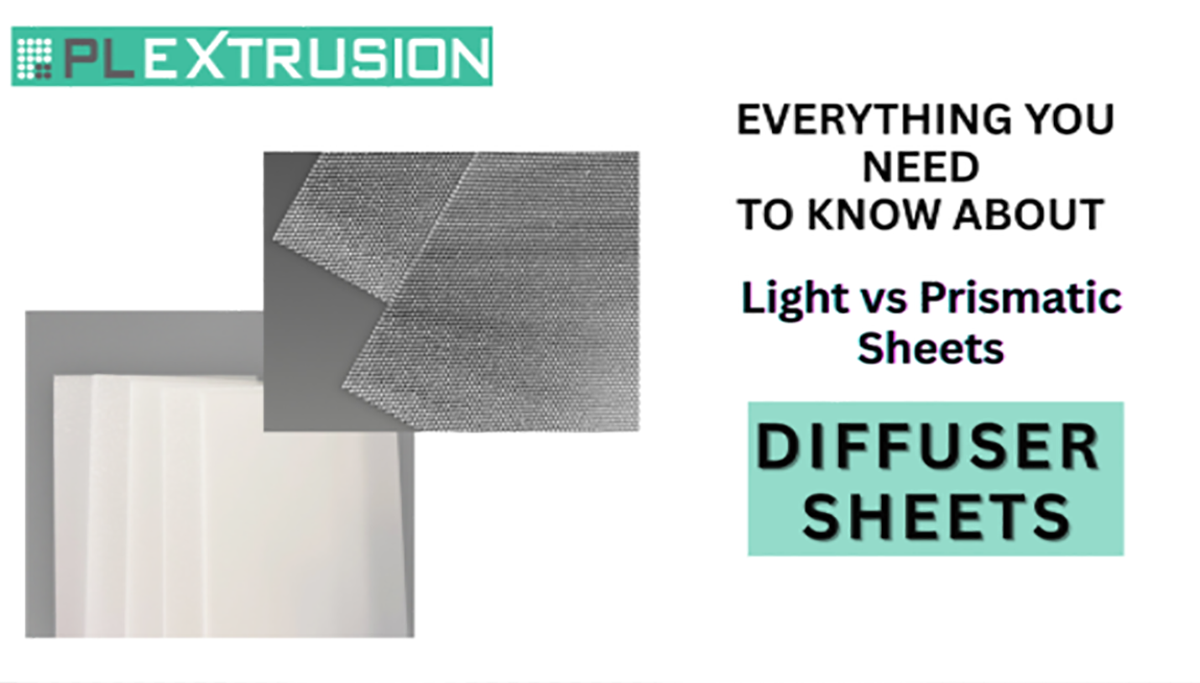
A prismatic diffuser sheet is an optical sheet with a patterned surface that redirects and distributes light in a controlled manner rather than depending only on diffuse scattering.
The prism geometry changes the direction of transmitted light and can be used to improve light distribution and manage glare.
Prismatic diffuser sheets are commonly considered for:
PMMA prismatic sheet product information describes prismatic surface geometry, approximately 80%–90% transmission depending on finish and thickness, and typical thicknesses of 1.0–2.0 mm for its listed grades.
The primary difference is how each sheet manages the emitted light.
Prismatic diffuser sheets are commonly considered for:
| Parameter | Light Diffuser Sheet | Prismatic Diffuser Sheet |
|---|---|---|
| Primary function | Scatter and soften light | Redirect and control light |
| Surface | Textured, satin, matte or similar | Patterned/prismatic |
| Light appearance | Soft and uniform | More controlled distribution |
| LED hiding | High depending on grade/design | Application-dependent |
| Glare control | Application-dependent | Can provide controlled distribution |
| Typical use | General LED illumination | Commercial, office and controlled lighting |
| Design focus | Uniform appearance | Optical direction and distribution |
Key statement: Choose a standard diffuser when uniform soft illumination is the primary objective and consider a prismatic diffuser when controlled light distribution is also an important design requirement.
Light transmission describes the proportion of visible light passing through the diffuser.
For example, a diffuser specified at approximately 75% transmission allows substantially more light through than one designed for a much lower transmission, but transmission alone does not determine perceived uniformity.
Higher transmission is not automatically better.
The correct transmission is the one that provides the required balance between brightness, LED hiding, uniformity, and visual comfort.
2. Diffusion levelDiffusion determines how broadly the light is scattered.
A higher diffusion requirement may improve hotspot hiding but can also reduce the amount of directly transmitted light.
3. ThicknessThickness affects:
Plextrusion lists PC diffuser sheets in a thickness range of 0.8–4.0 mm.
4. Surface textureCommon surface finishes can include:
Surface texture can influence both appearance and light distribution.
5. Impact resistanceImpact resistance becomes particularly important for:
UV exposure can affect some plastics over time. For outdoor applications, ask specifically whether the selected material and grade are suitable for the expected UV exposure.
7. Flammability performanceWhere the luminaire or equipment specification requires a flammability rating, the material grade should be selected and tested according to the applicable standard.
For example, UL 94 includes vertical burning classifications such as V-0, V-1 and V-2. UL explains that the test evaluates burning, afterglow and flaming drips under the applicable procedure.
Important: A material's UL 94 rating should not be treated as a blanket certification for the finished lighting product. The end product may have additional safety and compliance requirements.
There is no single thickness that is ideal for every LED lighting application.
A practical starting framework is:
| Thickness | Possible Application Direction |
|---|---|
| 0.8 mm | Slim fixtures and lightweight applications |
| 1.0 mm | Compact lighting and display applications |
| 1.2 mm | LED panel and luminaire applications |
| 1.5 mm | Commercial and general-purpose fixtures |
| 2.0 mm | More rigid lighting assemblies |
| 3.0–4.0 mm | Applications requiring greater sheet rigidity |
These are application-oriented reference points rather than universal design rules. Final thickness should be validated against fixture dimensions, mounting method, LED spacing, thermal conditions, impact requirements, optical performance, and material grade.
A practical way to select a diffuser is to evaluate six parameters:
The 6-Point Diffuser Selection FrameworkKey statement: The best LED diffuser sheet is the one that meets the application's optical, mechanical, environmental, dimensional, and manufacturing requirements simultaneously.
LED diffuser sheets are used across a wide range of industries because lighting systems vary significantly in geometry, environment, optical requirements, and appearance.
LED Lighting & IlluminationApplications include:
The primary requirements are generally light uniformity, LED hiding, transmission, glare management, and dimensional consistency.
AutomotiveDiffuser materials can be considered for:
Automotive applications require careful validation of temperature, vibration, chemical exposure, optical stability, and applicable vehicle standards.
Consumer ElectronicsPossible applications include:
Compact geometry and optical consistency are often important.
Electrical & Electronics ManufacturingDiffuser sheets can be incorporated into:
Material selection should consider heat, flame performance, dimensional stability, and electrical-equipment requirements.
Signage & AdvertisingDiffuser sheets are widely applicable to:
The key requirements are often LED hiding, brightness uniformity, colour appearance, weather resistance, and fabrication flexibility.
Retail & Commercial InteriorsApplications include:
Diffusers help create clean and consistent illumination for merchandise and interior spaces.
Architecture & Interior DesignArchitectural applications can include:
The designer may prioritize optical appearance, surface finish, formability, colour consistency, and customized dimensions.
Display & Digital SignageDiffuser sheets can be used in:
Uniform illumination is particularly important when the illuminated surface is directly visible.
Smart Home & IoTApplications include:
Diffuser selection should be coordinated with compact fixture dimensions, thermal design, LED spacing, and desired visual appearance.
Aerospace & DefenseSpecialized applications may require:
Material selection should always follow the applicable aerospace or defense specification rather than relying only on generic plastic properties.
Medical & Healthcare EquipmentPossible applications include:
The selected material should be evaluated for cleanability, chemical exposure, optical performance, and relevant equipment requirements.
Industrial & MachineryDiffuser sheets can be incorporated into:
Impact resistance, temperature, chemical exposure and flame performance can become important.
Transportation & RailwaysApplications can include:
Plextrusion specifically identifies railway applications for selected PC diffuser grades and lists UL 94 V0 and HL-3 R4 grades for railway requirements on its PC diffuser product page.
Marine & ShipbuildingPotential applications include:
Marine applications require careful consideration of humidity, salt exposure, fire performance and applicable marine standards.
Solar & Renewable EnergyPotential applications include:
Outdoor exposure and UV resistance should be evaluated before material selection.
Furniture & Architectural LightingApplications include:
Plextrusion identifies furniture applications such as wardrobes and cabinets for its diffuser profiles.
Hospitality & HotelsApplications include:
Appearance, comfort, colour consistency and custom fixture integration are important considerations.
Construction & Building MaterialsDiffuser sheets can be integrated into:
Potential applications include:
Compact design and thermal compatibility should be considered.
OEM & Contract ManufacturingOEMs benefit from diffuser sheets that can be specified around their exact:
Custom diffuser development is especially valuable when the diffuser is an integrated component of a proprietary luminaire.
Yes, LED diffuser sheets can be customized by material, thickness, transmission, surface texture, dimensions, shape, and application-specific optical requirements.
Common customization parameters| Parameter | Possible Requirement |
|---|---|
| Material | PC / PMMA / PS |
| Thickness | Application-specific |
| Light transmission | Grade-dependent |
| Surface | Matt / Satin / Glossy / Embossed / Prismatic |
| Shape | Round / Square / Rectangular / Custom |
| Dimensions | Standard or custom |
| Flammability | Application-specific grade |
| Environment | Indoor / Outdoor / Industrial |
| Cutting | Laser / Panel Saw |
| Packaging | Application and transportation dependent |
For diffuser plates, considering thickness, light transmission, impact resistance, material, size/shape, surface pattern, flammability grade, and usage environment during customization.
An OEM or lighting manufacturer can reduce development time by providing a clear technical requirement at the quotation stage.
Recommended RFQ informationKey statement: A diffuser supplier can develop a more accurate solution when the optical requirement is defined together with the fixture geometry and operating environment.
Thickness affects more than mechanical rigidity.
Increasing thickness can influence:However, thicker does not automatically mean better diffusion.
The correct thickness is the minimum practical thickness that satisfies the required optical, structural, environmental, fabrication, and safety conditions.
For example, a compact indoor LED panel may require a different thickness from a large outdoor light box or a transport lighting assembly.
Light transmission and diffusion should be considered together.
Imagine two diffuser sheets:Neither may be ideal.
The design objective is to achieve an appropriate balance between:
Brightness + Uniformity + LED Hiding + Glare Control + Optical Appearance
This is why diffuser selection should not be based solely on a single specification such as transmission percentage.
The cheapest diffuser may not provide the required optical performance or durability.
Mistake 2: Looking only at light transmissionHigh transmission does not necessarily mean better visual performance.
Mistake 3: Ignoring LED spacingLED pitch and diffuser distance strongly influence hotspot visibility.
Mistake 4: Choosing the wrong polymerPS, PC and PMMA have different performance characteristics.
Mistake 5: Ignoring UV exposureOutdoor lighting requires appropriate consideration of UV stability.
Mistake 6: Ignoring temperatureLED luminaires generate heat. The diffuser must be compatible with the actual operating conditions.
Mistake 7: Treating a material rating as an end-product certificationA material-level rating such as UL 94 should not be confused with certification of the complete luminaire.
Mistake 8: Not testing a prototypeA diffuser that looks suitable on paper may behave differently once installed with the actual LED source and fixture geometry.
A professional diffuser-sheet specification can include checks for:
Optical qualityDepending on the final application, relevant requirements may include:
The final compliance requirement must always be established from the finished product's applicable standard and end-use environment.
Yes,Yselected LED diffuser sheets can be used for outdoor lighting, but the material grade must be matched to UV exposure, temperature, moisture, impact, weathering, and the optical requirements of the fixture.
PMMA is often considered where optical clarity and UV/weathering performance are important, while UV-stabilized polycarbonate grades can be considered where greater impact resistance is required.
PS may be more suitable for controlled indoor environments unless a specific grade has been qualified for the outdoor conditions.
Outdoor suitability is a grade-specific property, not simply a polymer-family property.
Plastic diffuser sheets are typically produced through a controlled polymer processing and sheet-forming process.
A simplified manufacturing sequence is:Raw material selection → optical formulation → extrusion/sheet formation → surface treatment or texturing → cooling → dimensional control → cutting → inspection → packing
The exact process depends on:Plextrusion states that its manufacturing approach includes indigenous diffusion technology, clean-room manufacturing conditions, and in-house laser cutting for customized diffuser shapes and sizes.
A simplified selection matrix can help:
| Application | Recommended Starting Consideration |
|---|---|
| LED Panel | PS / PC / PMMA based on optical and structural requirements |
| Office Lighting | High uniformity and glare management |
| Retail Lighting | Optical appearance and colour consistency |
| Outdoor Lighting | UV/weather resistance + impact resistance |
| Railway Lighting | Qualified PC grades and applicable railway requirements |
| Industrial Lighting | Impact, temperature and mechanical requirements |
| Signage | LED hiding + transmission + weathering |
| Architectural Lighting | Optical appearance + surface finish |
| Furniture Lighting | Thin, lightweight, custom-cut solutions |
| Medical Equipment | Optical uniformity + cleanability + applicable equipment requirements |
| Automotive | Temperature, vibration, chemical and vehicle-specific requirements |
| Aerospace | Weight, fire, environmental and qualification requirements |
| OEM | Custom optical and dimensional specification |
This table should be treated as a starting point. Final material selection should be validated against the actual product design.
Plextrusion takes an application-oriented approach to diffuser development rather than treating every lighting project as a standard-sheet requirement.
The company's stated customization parameters include:The company also states that it can provide custom shapes through in-house laser cutting and panel-saw facilities.
Why this matters for OEMsAn OEM may not need a generic diffuser sheet.
It may need a diffuser that:
The proprietary perspective: For modern LED products, diffuser selection should be treated as an optical engineering decision, not simply as a plastic purchasing decision.
Plextrusion India LLP is a Mumbai-based manufacturer of plastic diffuser sheets and profiles serving LED lighting and signage applications, with its manufacturing facility located in Bhiwandi near Mumbai.
The company's stated capabilities include:It has more than 12 years of industry experience and supplies products to customers in India and abroad.
Its Bhiwandi manufacturing location provides logistical access to Mumbai and other Indian markets, while its custom manufacturing capabilities allow lighting manufacturers and OEMs to specify diffuser solutions around their product requirements.
For a custom diffuser project, the technical requirement can be evaluated around the material, thickness, transmission, diffusion, surface texture, shape, dimensions, LED configuration, environmental exposure, and applicable compliance requirements.
For an accurate quotation or technical discussion, provide the following:
This information gives a diffuser manufacturer the technical context needed to recommend an appropriate material and grade.
An LED diffuser sheet is an optical plastic sheet that spreads and softens LED light, reduces visible LED hotspots, and helps create more uniform illumination.
There is no universal best material. PMMA is commonly considered for optical clarity and UV stability, PC for impact resistance and demanding applications, and PS for many cost-sensitive indoor lighting applications.
PC generally offers higher impact resistance, while PMMA generally provides excellent optical clarity and UV/weathering characteristics. The appropriate choice depends on the application's mechanical, optical, thermal, and environmental requirements.
Thickness depends on the application. Plextrusion lists PC diffuser sheets from 0.8 mm to 4.0 mm.
The appropriate transmission depends on the LED source, fixture geometry, desired brightness, diffusion level, and LED hiding requirement. A higher transmission value is not automatically the best choice.
Yes. Properly engineered diffuser sheets can significantly reduce visible LED points. However, hotspot hiding also depends on LED spacing, diffuser distance, optical design, and fixture geometry.
Yes, selected grades are suitable for outdoor applications. UV exposure, moisture, temperature, impact and weathering requirements should be evaluated before selecting the material.
Yes. Diffuser sheets can be customized by material, thickness, transmission, surface texture, dimensions, shape and application-specific requirements. Plextrusion offers custom shapes and cut-to-size solutions.
Yes. Plextrusion states that it has in-house laser-cutting capability for custom diffuser shapes and sizes.
Yes. Selected polycarbonate diffuser grades can be used in railway lighting applications when the material and finished luminaire satisfy the applicable railway requirements. Plextrusion lists railway applications for selected PC diffuser grades.
Yes. LED diffuser sheets are widely used in illuminated signage, backlit signboards, light boxes, displays and advertising applications where LED hiding and uniform illumination are important.
Start with the LED configuration, required transmission, diffusion level, thickness, material, surface finish, operating environment, dimensions, flammability requirement and applicable product standards. Prototype testing with the actual LED system is recommended before production approval.
Send the required material, dimensions, thickness, transmission, surface texture, LED arrangement, application environment, quantity, drawing and any specific impact, UV or flammability requirements.
The right LED diffuser sheet is selected by balancing light transmission, diffusion, LED hotspot hiding, material strength, thickness, surface finish, environmental resistance, fixture geometry, and compliance requirements. PC, PMMA, PS and prismatic diffuser sheets each serve different application needs.
For LED lighting manufacturers, signage companies, OEMs, architects, electrical equipment manufacturers and industrial users, the most reliable approach is to define the optical and mechanical requirements first and then select the material and grade.
If you are developing an LED luminaire, signage system, architectural light, furniture light, transportation lighting product or OEM lighting assembly, provide the drawing, dimensions, LED configuration and optical requirements.